US Middle School Math Competitions: Complete Parent Guide for 2026
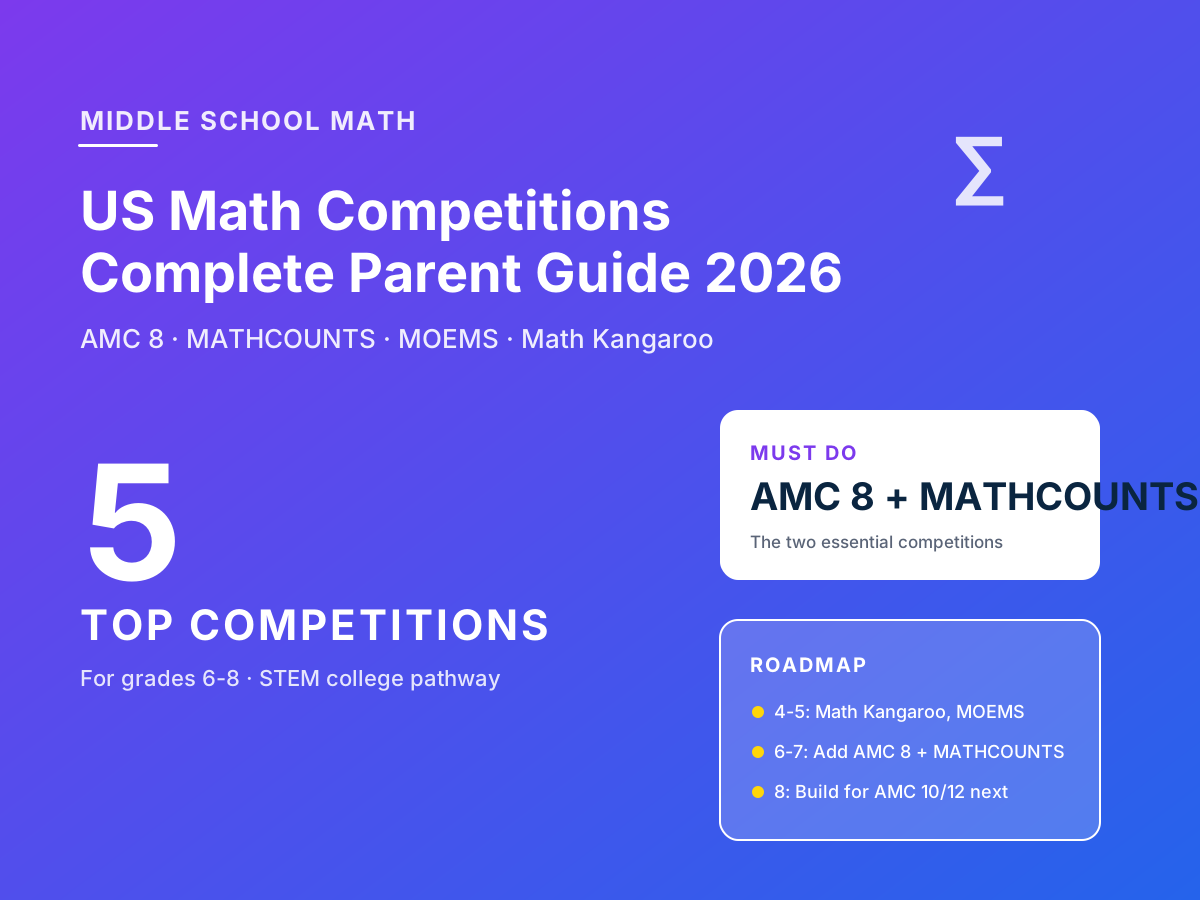
Everything immigrant parents need to know about AMC 8, MATHCOUNTS, MOEMS, Math Kangaroo, and Math League — the 5 essential math competitions for grades 6-8 and the path to top STEM colleges.
If your middle schooler shows talent in math, you probably wonder: "Is school math enough?" The answer for college-bound STEM students is clear: no, it's not enough.
Top private high schools, gifted programs, AP/Honors tracks, and STEM-focused colleges (MIT, Caltech, Princeton, Stanford) look for one specific signal — middle school math competition experience. They want to know if your child has engaged with math seriously outside the classroom, not just earned A's in school.
This complete guide covers the 5 essential US math competitions for grades 6-8, with a year-by-year roadmap and prep strategy for immigrant families.
Texas families: Get math credits early with Texas CBE™ →Why Math Competitions Matter for College Admissions
US colleges and competitive private high schools use math competition results as objective evidence of mathematical ability. School grades vary by school, but AMC 8 scores and MATHCOUNTS placements are nationally normed.
What competition experience signals:
- Genuine intellectual curiosity beyond required coursework
- Problem-solving stamina under timed pressure
- Ability to handle non-routine problems (different from textbook drills)
- Long-term commitment to STEM excellence
- Comparative ranking vs. national peers
For students aiming at top STEM colleges, having multi-year AMC scores (AMC 8 → AMC 10 → AMC 12 → AIME) on a college application is increasingly expected.
The Two Essential Competitions: AMC 8 & MATHCOUNTS
These two are non-negotiable. They're the foundation of the US math competition ecosystem. Everything else is supplementary.
1. AMC 8 — The Most Recognized Entry Point
Operated by: Mathematical Association of America (MAA) Eligible: Students in grade 8 or below, under 14.5 years old by exam date Format: 25 multiple-choice questions, 40 minutes 2026-27 Test Window: January 21-27, 2027 (one-week window) Where to take it: Your child's school registers (or via local universities, math circles, learning centers) Cost: Usually free (covered by school) Official site: maa.org/student-programs/amc
Why it's #1: AMC 8 scores are the most commonly requested objective math metric for top US private high school admissions. It's also the entry to the prestigious AMC 10 → AMC 12 → AIME → USAMO → IMO competition pipeline that elite STEM colleges watch carefully.
Topics covered:
- Algebra basics
- Geometry and trigonometry foundations
- Number theory
- Counting and probability
- Logic and pattern recognition
Prep level: School math + basic Algebra 1 is enough to pass. Top 5% requires going beyond — strong counting, probability, number theory, and plane geometry skills.
2. MATHCOUNTS — The Pinnacle of Team Math Competition
Operated by: MATHCOUNTS Foundation (founded 1983, sponsored by RTX) Eligible: US students in grades 6-8 (max 3 years of participation) Participation: School team (4 students) OR NSC (Non-School Competitor, individual)
2026 Season Schedule:
- School Round: November 2025 - January 2026 (school-internal)
- Chapter Round: February 1-28, 2026
- State Round: March 1-31, 2026
- National Competition: May 10-11, 2026 (Hilton Orlando Lake Buena Vista, FL)
Cost: $45/student for school registration, $70/student for NSC (more after deadlines) Official site: mathcounts.org
Competition Format:
| Round | Format | Timing | Calculator |
|---|---|---|---|
| Sprint Round | 30 problems | 40 min | NO |
| Target Round | 4 sets × 2 problems | 6 min/set | YES |
| Team Round | 10 problems (4-person team) | 20 min | YES |
| Countdown Round | 1:1 head-to-head | Fast pace | NO |
Why it matters: AMC 8 is individual; MATHCOUNTS is team competition + live performance under pressure. It's one of the only formal venues where students experience high-pressure rapid math + collaboration. In Texas, the Texas Society of Professional Engineers (TSPE) administers state-level competition.
Important note: To register as NSC (individual), your child's school must NOT be registered with MATHCOUNTS. Check the official school registration list at mathcounts.org first.
The Next Tier: 3 Competitions That Add Depth
3. MOEMS — Math Olympiads for Elementary and Middle Schools
Eligible: Grades 4-6 (Division E) / Grades 6-8 (Division M) Format: Monthly contests November-March (5 total). 30 minutes, 5 problems each Registration: School/learning center group registration only (no individual registration) Official site: moems.org Annual participants: 120,000+ across 40 countries
Why it works: Lower difficulty than AMC 8 but emphasizes creative problem-solving over speed calculation. Perfect for first-time competition exposure for 4th-5th graders, or for 6th graders who are strong in math but new to competitions.
4. Math Kangaroo — The Best Entry Point
Eligible: Grades 1-12 (separate test per grade) Format: 24-30 multiple-choice questions, 75 minutes Test date: Third Thursday of March annually Registration fee: $21 (individual registration available!) Official site: mathkangaroo.org
Why we recommend it for first competition:
- Individual registration possible (no school dependency)
- Logic and creativity over calculation — accessible to students who haven't accelerated school math
- Generous awards and prizes — encouraging for first-time competitors
- Global competition held in 60+ countries simultaneously
- Lowest barrier to entry of all major competitions
Especially valuable for: Immigrant students unfamiliar with US competition culture, students whose schools don't host competitions.
5. Math League — National Reach with Regional Rankings
Eligible: Grades 4-12 Format: Grade-specific contests, typically 30-40 problems in 30 minutes Official site: mathleague.com
Why it's useful: National league with clear regional rankings — great for understanding where your child stands relative to peers. Top scorers receive invitations to summer camp at College of New Jersey. Less prestigious than AMC but easier to enter consistently.
Year-by-Year Roadmap
| Grade | Starting Competitions | Core Goals |
|---|---|---|
| 4-5 | Math Kangaroo, MOEMS (Division E) | Enjoy math, warm up to competition format |
| 6 | Math Kangaroo + MOEMS (Division M) + AMC 8 (if ready) | Get comfortable with competition format |
| 7 | AMC 8 + MATHCOUNTS School Round | Serious entry; try out for school team |
| 8 | AMC 8 + MATHCOUNTS Chapter/State + AMC 10 (challenging) | Bridge to high school competition track |
5 Critical Things Every Parent Must Know
1. Confirm Your School's Registration First
AMC 8 and MATHCOUNTS both require school or NSC registration — your child can't register directly. Ask your child's math teacher in September or October about their plans for the year.
2. Earlier Is Better — Even If They Don't "Win"
Taking AMC 8 in 6th grade isn't "wasted" if scores are low. It builds 3 years of cumulative track record showing improvement. A 6th grader scoring 12 → 7th grader scoring 18 → 8th grader scoring 22 tells a much stronger story than just one score in 8th grade.
3. Don't Register for Everything
Five competitions = burnout for an 11-year-old. Pick AMC 8 + MATHCOUNTS as your main focus, then add 1-2 others based on your child's energy and interest.
4. Get Ahead of School Math
The single biggest predictor of success in middle school competitions is completing Algebra 1 by 7th grade. Without that foundation, AMC 8's later problems and MATHCOUNTS' Target Round are inaccessible.
If your school doesn't accelerate, you need to do it yourself. This is where Texas CBE™ and Texas CBE™ become game-changers.
5. Use NSC If Your School Isn't Registered
MATHCOUNTS allows individual NSC registration. AMC 8 can be taken at nearby universities, math circles, or learning centers if your school doesn't host. Don't let your school's lack of participation stop your child.
How to Get Math Ahead: Texas CBE & Michigan Test Out
About 50% of math competition success comes from being one year ahead of standard school math. If your child completes Algebra 1 by 7th grade and Geometry by 8th grade, AMC 8 and MATHCOUNTS become much more approachable.
Accelerate Math with Texas CBE™ (Works Nationwide)
texascbe.com is the platform we recommend for math acceleration prep. Originally built for Texas Credit by Examination, the platform serves students nationwide because Algebra 1, Geometry, and Algebra 2 content is standardized across all 50 states ("same skills, different labels").
Recommended acceleration strategy:
- 6th grade summer: prep for Algebra 1 test-out
- 7th grade fall: test out of Algebra 1 → start Geometry
- 7th grade summer: prep for Geometry test-out
- 8th grade: test out of Geometry → start Algebra 2
By 8th grade, your child has 2-3 years of advanced math under their belt — exactly what AMC 8 and MATHCOUNTS reward.
Why this works in any state:
- Texas families: Use the official Texas Credit by Exam (CBE) program
- Michigan families: Use the Michigan Test Out program (PA 335 of 2006, 80%+ to pass)
- New York families: NY Regents/proficiency assessments
- All other states: Most have credit-by-exam, EOC, or course-challenge pathways
Texas CBE™ provides AI-powered tutoring, multi-language support, and free sample questions to start — and the Algebra/Geometry content matches what your state's exam will test.
Start FREE Math Acceleration Prep on Texas CBE™ →What About AMC 10 and AMC 12?
AMC 8 graduates move to AMC 10 and AMC 12 in high school. Quick preview:
| Test | Eligible | When | Why It Matters |
|---|---|---|---|
| AMC 10 | Grade 10 or below | November | Path to AIME (top 2.5%) |
| AMC 12 | Grade 12 or below | November | Same, plus more advanced topics |
| AIME | AMC qualifiers | February | Path to USAMO |
| USAMO | AIME top scorers | April | Path to IMO Team |
2026-27 AMC 10/12 dates: November 5, 2026 (Wednesday) and November 13, 2026 (Friday).
If your child is performing well on AMC 8 by 8th grade, they should attempt AMC 10 the same year. This builds the multi-year track record that elite colleges want.
How Top STEM Colleges Use This Data
Admissions officers at MIT, Caltech, Princeton, and similar schools regularly evaluate:
| Achievement | Signal |
|---|---|
| Top 5% AMC 8 | Strong math ability for middle schooler |
| MATHCOUNTS Chapter qualifier | Serious competitor |
| MATHCOUNTS State qualifier | Top 1-2% nationally |
| AMC 10 Honor Roll (top 5%) | Real college-level talent |
| AIME qualifier | Top 2.5% in country |
| USAMO qualifier | World-class talent |
A college application showing AMC 8 (8th grade) → AMC 10 (9th-10th) → AIME (10th-11th) demonstrates years of consistent math excellence — exactly the trajectory top schools recruit.
Common Mistakes Parents Make
1. Starting Too Late
Waiting until 8th grade to begin competition prep means missing 2-3 years of learning curve. Start in 4th-5th grade with Math Kangaroo.
2. Confusing Competitions with Accelerated Math
Competitions test problem-solving skills, not just advanced topics. A child can be in AP Calculus and still struggle with AMC 8 problems. Both tracks need separate prep.
3. Burning Out the Student
Pushing for "every competition possible" can kill the love of math. Pick 2-3 competitions and prep seriously for those.
4. Ignoring Foundation Work
You can't skip the basics. Solid arithmetic, algebra, and geometry foundations are non-negotiable before competition strategy makes sense.
5. Not Tracking Multi-Year Progress
Save every competition result. Build a record showing improvement over time. This narrative is what college admissions value, not single peak scores.
Bottom Line
For US-bound STEM students, middle school math competitions are not optional — they're the foundation of a competitive college application. The five essential competitions (AMC 8, MATHCOUNTS, MOEMS, Math Kangaroo, Math League) each play a specific role.
The two essentials: AMC 8 and MATHCOUNTS. The rest are supplementary.
The acceleration enabler: Get math ahead of school standards. Texas CBE™ (texascbe.com) provides Algebra 1, Geometry, and Algebra 2 prep that works for students in any state — the math content is standardized nationwide. Free practice to start, then affordable structured prep.
Action steps for this week:
- Identify which competitions your child is eligible for this year
- Contact your child's math teacher about school registration plans
- If school doesn't participate, set up NSC registration or find local hosting
- Try free sample questions on Texas CBE™ to start math acceleration
- Plan a 2-3 year acceleration roadmap
Your child's path to MIT or Caltech could start with one math competition this year. Don't wait — the kids who win in 8th grade started in 4th grade.
Start FREE Math Prep on Texas CBE™ →