W2 vs Schedule C in Texas: Tax Comparison Explained Simply (2026 Guide)
If you earn $100,000 as a W2 employee vs as a self-employed worker (Schedule C) in Texas, your tax bill is different. Here's a clear breakdown of payroll tax, deductions, QBI, and what you actually take home.
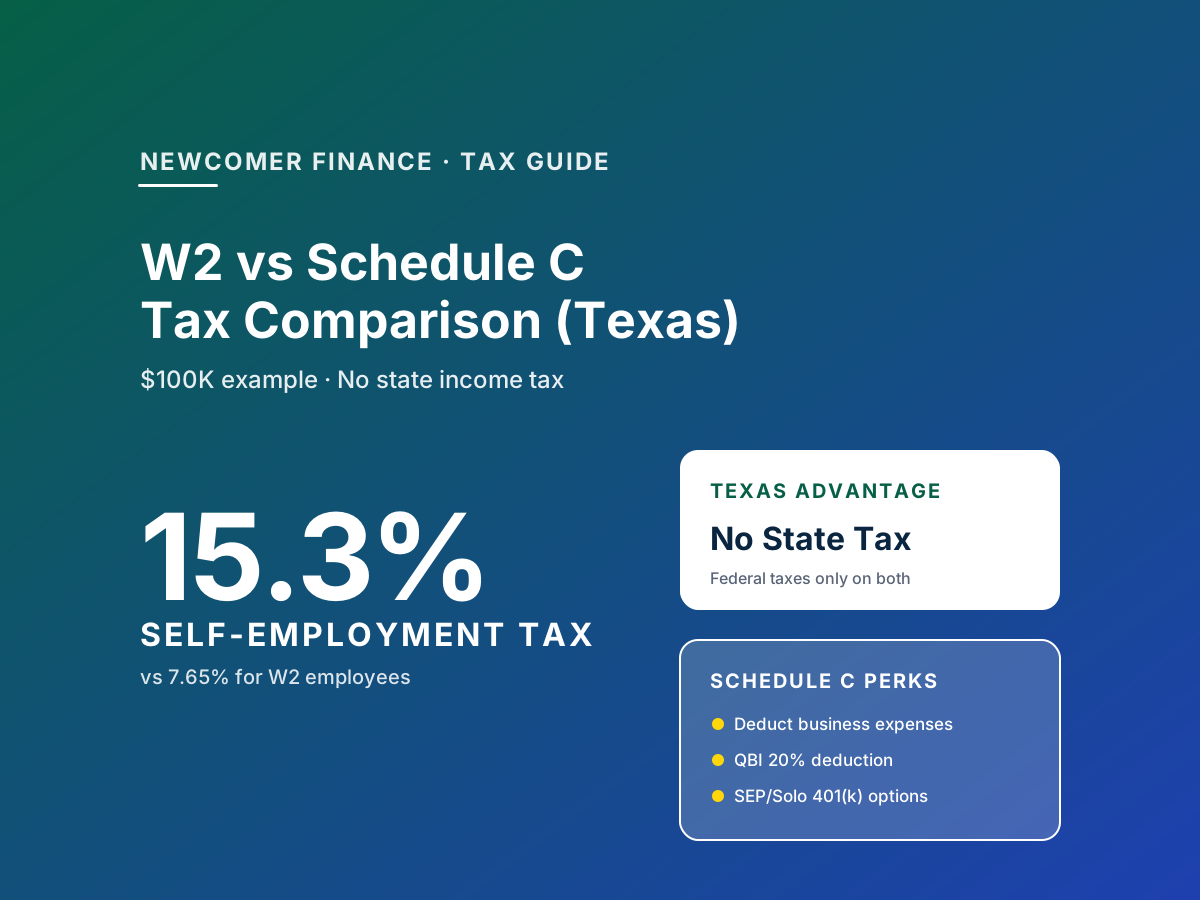
Imagine two Texans, both earning $100,000 a year. One gets a W2 paycheck from a company. The other is self-employed (gig worker, freelancer, small business owner) and reports income on Schedule C. Same income on paper — but their tax bills are very different.
This guide breaks down those differences in plain English. Texas is one of the simplest states for this comparison because there's no state income tax — so we focus purely on federal taxes.
Quick Summary: W2 vs Schedule C at $100K
| Tax Component | W2 Employee | Schedule C (Self-Employed) |
|---|---|---|
| Federal income tax | Yes | Yes |
| State income tax (Texas) | None | None |
| Social Security + Medicare | 7.65% you pay | 15.3% you pay (SE tax) |
| Business expense deductions | Almost none | Yes (Schedule C Part II) |
| QBI 20% deduction | Not eligible | Eligible (Section 199A) |
| SE tax half-deduction | N/A | Yes (above-the-line) |
The headline: Self-employed workers pay more payroll tax but have more deductions available. Whether they come out ahead depends on the expenses and QBI eligibility.
Part 1: Social Security & Medicare — The "FICA / SE Tax" Difference
This is the biggest mechanical difference between W2 and Schedule C.
W2 Employee (FICA Tax)
When you earn a W2 paycheck, FICA tax is split between you and your employer:
| Component | Your Share | Employer's Share | Total |
|---|---|---|---|
| Social Security | 6.2% | 6.2% | 12.4% |
| Medicare | 1.45% | 1.45% | 2.9% |
| Total | 7.65% | 7.65% | 15.3% |
On $100K W2 income: You pay $7,650 in FICA. The employer pays another $7,650 separately (not from your check).
Schedule C (Self-Employment Tax)
When you're self-employed, you pay BOTH halves yourself — there's no employer:
Self-Employment (SE) Tax = 15.3% of net earnings
The calculation has a few steps:
- Take your Schedule C net profit
- Multiply by 92.35% (this is "net earnings from self-employment")
- Multiply by 15.3% for the SE tax
On $100K Schedule C net profit:
- $100,000 × 92.35% = $92,350 (net earnings)
- $92,350 × 15.3% = $14,130 in SE tax
That's about $6,480 more than the W2 worker pays in FICA on the same income.
Important: SE Tax Has Caps
The Social Security portion (12.4%) only applies up to a wage base limit. For 2025, that limit is $176,100. Earnings above that don't owe additional Social Security tax — but Medicare (2.9%) still applies on all earnings.
The Silver Lining: Half of SE Tax is Deductible
Self-employed workers can deduct half of their SE tax as an "above-the-line" deduction. This reduces your taxable income (not the SE tax itself).
On our $100K example:
- SE tax: $14,130
- Half deduction: $7,065 off your taxable income
This doesn't fully cover the gap, but it softens it.
Part 2: Federal Income Tax — Roughly Equal (Before Deductions)
Federal income tax brackets apply identically to W2 wages and Schedule C net profit. For a single filer at $100K in 2025:
| Tax Bracket | Income Range | Rate |
|---|---|---|
| 10% | $0 - $11,925 | 10% |
| 12% | $11,925 - $48,475 | 12% |
| 22% | $48,475 - $103,350 | 22% |
| 24% | $103,350 - $197,300 | 24% |
A single filer at $100K (after standard deduction of $15,000) is taxed on $85,000:
- 10% on first $11,925 = $1,192
- 12% on $11,925-$48,475 = $4,386
- 22% on $48,475-$85,000 = $8,036
- Total federal income tax ≈ $13,614
This applies to BOTH W2 and Schedule C workers identically (at the same taxable income).
But — taxable income differs because of the deductions available to each path.
Part 3: The Schedule C Advantage — Business Expense Deductions
This is where self-employed workers can level the playing field (or even come out ahead).
What You Can Deduct on Schedule C
Almost any "ordinary and necessary" business expense. Common categories:
| Category | Examples |
|---|---|
| Advertising | Marketing, SEO tools, ads |
| Office expense | Software subscriptions, domain registration |
| Rent | Cloud hosting, office rent |
| Supplies | Materials, small tools |
| Travel | Mileage, business trips |
| Meals | 50% of qualifying business meals |
| Equipment | Computers, cameras (depreciated or Section 179) |
| Home office | Square footage % of home expenses |
| Stripe/PayPal fees | Payment processor costs |
| Internet & phone | Business-use portion |
| Professional services | Accountant, lawyer fees |
Example: $100K Schedule C with $20K Expenses
| Item | Amount |
|---|---|
| Gross revenue | $100,000 |
| Business expenses | -$20,000 |
| Net profit (taxed) | $80,000 |
Now taxes are calculated on $80,000 instead of $100,000. That's a real reduction.
W2 Workers? Almost No Equivalent
W2 employees got their unreimbursed business expense deductions eliminated under the 2017 Tax Cuts and Jobs Act. With rare exceptions (military, qualified performing artists), W2 workers cannot deduct their own business-related expenses.
This is a structural advantage for self-employed workers — especially in high-margin online businesses where revenue is much higher than expenses.
Part 4: QBI — The 20% Deduction Most People Don't Know
The Qualified Business Income (QBI) Deduction under Section 199A is one of the most valuable deductions for self-employed workers — and W2 employees don't get it.
How QBI Works
If you're self-employed and eligible, you can deduct up to 20% of your qualified business income from your federal taxable income.
On our $80K net profit example:
- QBI deduction: $80,000 × 20% = $16,000 reduction to taxable income
- New taxable income: $80,000 - $16,000 = $64,000
Income Limits for Full QBI
The full 20% QBI is available for taxable incomes below:
- Single: $241,950 (2025)
- Married filing jointly: $483,900 (2025)
Above these limits, restrictions apply (Specified Service Trade or Business rules). For most small business owners and freelancers, the full 20% applies.
Effective Tax Rate Impact
QBI alone can reduce a self-employed worker's effective tax rate by 3-5 percentage points compared to a W2 worker at the same income. This is huge.
Part 5: Apples-to-Apples Example — $100K Comparison
Let's calculate take-home pay for both, assuming single filer, Texas resident, $100K gross income, standard deduction:
W2 Employee at $100K
| Item | Amount |
|---|---|
| Gross income | $100,000 |
| FICA tax (7.65%) | -$7,650 |
| Standard deduction | -$15,000 |
| Taxable income | $77,350 |
| Federal income tax | -$11,679 |
| Take-home pay | ~$80,671 |
Schedule C with $20K Expenses + Full QBI
| Item | Amount |
|---|---|
| Gross revenue | $100,000 |
| Business expenses | -$20,000 |
| Net profit | $80,000 |
| SE tax (15.3% × 92.35%) | -$11,304 |
| Half SE tax deduction | (deducted from taxable) |
| Standard deduction | -$15,000 |
| QBI deduction (20% of net) | -$16,000 |
| Taxable income | $43,348 |
| Federal income tax | -$4,991 |
| Take-home pay | ~$83,705 |
In this scenario, the Schedule C worker takes home ~$3,000 more despite paying double the payroll tax — thanks to expense deductions and QBI.
Schedule C with Zero Expenses (High-Margin Online Business)
| Item | Amount |
|---|---|
| Gross revenue | $100,000 |
| Business expenses | $0 |
| Net profit | $100,000 |
| SE tax | -$14,130 |
| Half SE tax deduction | (deducted from taxable) |
| Standard deduction | -$15,000 |
| QBI deduction (20% of net) | -$20,000 |
| Taxable income | $57,935 |
| Federal income tax | -$7,995 |
| Take-home pay | ~$77,875 |
Even with zero expenses, the Schedule C worker takes home about $2,800 less than W2 — but QBI cushions much of the SE tax hit.
Part 6: Texas-Specific Considerations
No State Income Tax
Both W2 and Schedule C workers in Texas pay zero state income tax on their wages and business income. This is a huge advantage compared to states like California (13.3% top rate) or New York (10.9%).
Property Tax Trade-Off
Texas funds public services with high property taxes (average ~1.6-2.2% of home value annually). If you own a home, factor this into your total tax picture.
Sales Tax
Texas has a 6.25% state sales tax (up to 8.25% with local additions). This applies to both groups equally and isn't related to income type.
Part 7: What Counts as Schedule C Income
You report on Schedule C if you're a:
- Sole proprietor (no LLC, just SSN)
- Single-member LLC (default tax treatment)
- Independent contractor (receiving 1099 income)
- Freelancer (writing, design, consulting, etc.)
- Gig worker (Uber, DoorDash, etc.)
- Side business owner (Etsy shop, blog with ad income, etc.)
You do NOT need an LLC to report Schedule C income. A sole proprietor with just an SSN can deduct expenses and access QBI just the same.
Part 8: Key Tax Forms for Schedule C Filers
| Form | Purpose |
|---|---|
| Form 1040 | Main individual tax return |
| Schedule C | Business income & expenses |
| Schedule SE | Self-employment tax calculation |
| Form 8829 | Home office deduction details |
| Form 4562 | Depreciation (equipment, Section 179) |
| Form 8995 | QBI deduction simplified |
| Schedule 1 | Additional adjustments (SE tax deduction) |
This sounds like a lot, but tax software (TurboTax, FreeTaxUSA, etc.) handles them automatically.
Part 9: Quarterly Estimated Taxes — A Key Difference
W2 Workers: Taxes withheld from each paycheck automatically. You don't think about it.
Schedule C Workers: Must pay quarterly estimated taxes if you'll owe $1,000+ in taxes for the year. Due dates:
- Q1: April 15
- Q2: June 15
- Q3: September 15
- Q4: January 15 (following year)
Failure to pay quarterly results in underpayment penalties when you file. Set aside ~25-30% of your net profit for taxes throughout the year to avoid surprises.
Part 10: Common Schedule C Mistakes to Avoid
1. Mixing Personal and Business Expenses
The IRS will disallow deductions if you can't show clear separation. Use a separate business checking account and credit card.
2. Forgetting Quarterly Estimated Taxes
Penalties for underpayment can sting. Pay quarterly to avoid them.
3. Not Tracking Expenses Throughout the Year
Don't try to reconstruct expenses at tax time. Track monthly using a spreadsheet or accounting software.
4. Skipping QBI
Even tax software requires you to confirm eligibility. Don't leave $5,000+ on the table by missing this.
5. Over-Aggressive Home Office Deductions
The home office deduction has specific rules — exclusive and regular business use. Be honest; the simplified method ($5/sq ft up to 300 sq ft = $1,500 max) is safer than the actual expense method.
6. Not Saving for Self-Employment Taxes
W2 workers have taxes withheld automatically. Self-employed workers must self-discipline. Save 25-30% of every payment for taxes.
Part 11: When Schedule C is Better Than W2
Schedule C tends to win when you have:
- Significant legitimate business expenses (home office, equipment, software)
- QBI eligibility (most non-professional service businesses)
- High-margin online business (low expenses + QBI offsets SE tax hit)
- Ability to invest in retirement accounts (SEP-IRA, Solo 401(k) for self-employed only — much higher contribution limits than IRA)
Part 12: When W2 is Better Than Schedule C
W2 tends to win when you have:
- Employer benefits (health insurance, 401(k) match, paid leave)
- Income variability anxiety (W2 is predictable, Schedule C fluctuates)
- Low business expenses + low income (QBI benefit smaller)
- Lack of time/willingness to handle quarterly tax filing and bookkeeping
Part 13: Retirement Account Options
This is a major advantage for self-employed workers that's worth mentioning briefly.
Available to Both (with earned income)
- IRA / Roth IRA: Up to $7,000/year contribution ($8,000 if 50+)
Self-Employed Only — Much Higher Limits
- SEP-IRA: Up to 25% of net earnings, max $70,000 (2025)
- Solo 401(k): Up to $70,000/year (combined employee + employer contributions)
For high-earning self-employed workers, these accounts can shelter 5-10x more than a regular IRA — a major tax planning opportunity.
Where to Open These Accounts
Most major brokerages let you open IRA, Roth IRA, SEP-IRA, and Solo 401(k) accounts with no minimum and $0 commissions. Webull is one of our recommended platforms for newcomers because:
- $0 commissions on stocks, ETFs, and options
- $0 minimum to open an IRA or Roth IRA
- Fractional shares — invest in expensive stocks with as little as $5
- Mobile-friendly — manage retirement accounts on your phone
- Free real-time data and research tools
For Schedule C workers especially, opening a SEP-IRA and contributing 20-25% of net earnings each year can be the single biggest tax-saving move available.
Open a FREE Retirement Account on Webull →Part 14: Realistic Take-Home Snapshot
For a Texas single filer at $100K, here's the rough take-home picture:
| Scenario | Take-Home Pay (approx.) |
|---|---|
| W2 at $100K | ~$80,700 |
| Schedule C with $20K expenses + QBI | ~$83,700 |
| Schedule C with $0 expenses + QBI | ~$77,900 |
| Schedule C with $40K expenses + QBI | ~$87,000+ |
The "best" path depends heavily on your business expense structure.
Part 15: Final Strategy Tips
Track Everything from Day One
The moment you start earning Schedule C income, start tracking expenses. A simple spreadsheet works. Save every receipt.
Use Tax Software or a CPA
For freelancers/small business owners, TurboTax Self-Employed or FreeTaxUSA handle Schedule C well. For complex situations (multiple income streams, high earnings, audits), a CPA is worth the cost ($300-$800/year).
Don't Forget Quarterly Payments
Set calendar reminders for April 15, June 15, September 15, and January 15. Use IRS Direct Pay or Form 1040-ES.
Maximize Retirement Contributions
If you have self-employment income above $20K, consider SEP-IRA or Solo 401(k). These shelter income from BOTH SE tax (partially) and income tax.
Consider Texas's Other Advantages
Texas has no state income tax and lower business filing fees than many states. This makes it especially friendly for self-employed workers compared to high-tax states.
Bottom Line
In Texas, both W2 and Schedule C workers face only federal taxes (no state income tax). The big difference is:
- W2 workers pay less payroll tax (7.65% vs 15.3%) but get almost no deductions
- Schedule C workers pay more payroll tax but can deduct business expenses, claim 20% QBI, and use higher retirement contribution limits
For most freelancers and small business owners with reasonable expenses, the math often favors Schedule C — especially with QBI. For others, the predictability and benefits of W2 win.
The key is understanding your specific situation. Run the numbers with tax software or a CPA before assuming one path is always better.
Action steps for Schedule C earners:
- Open a separate business checking account
- Track expenses monthly (spreadsheet or app)
- Pay quarterly estimated taxes
- Don't forget the QBI deduction
- Open a SEP-IRA or Roth IRA to shelter income — Webull and other brokers offer these with $0 minimum
- Use tax software (TurboTax Self-Employed) or hire a CPA
Texas gives you a head start with no state income tax — make the most of it.
Start Building Tax-Sheltered Retirement Savings — Webull →A Note on International Payments
If you're a Schedule C worker who receives payments from international clients (common for freelance writers, designers, consultants), traditional bank wires can cost $25-$50 per transfer plus 2-4% exchange rate markup. Wise offers the real exchange rate with minimal fees — saving freelancers hundreds per year on international payments.
Receive International Client Payments with Wise →