How to Ask Your Texas School About CBE: Parent's Email Script + 4 Critical Questions
Want your child to test out via Credit by Examination? Here's the exact email template to send your counselor, the 4 questions to ask, and what to do if the school resists.
You've heard about Credit by Examination (CBE) in Texas. Maybe a friend's kid skipped Algebra I and started in Geometry. You want the same opportunity for your child — but you don't know where to start.
This guide gives you the exact email to send, the questions to ask, and the escalation path if the school resists. CBE is a legal right under Texas law; you just need to navigate the bureaucracy.
Start FREE CBE Practice on Texas CBE™ →The Two CBE Paths in Texas
Texas families have two routes to test out:
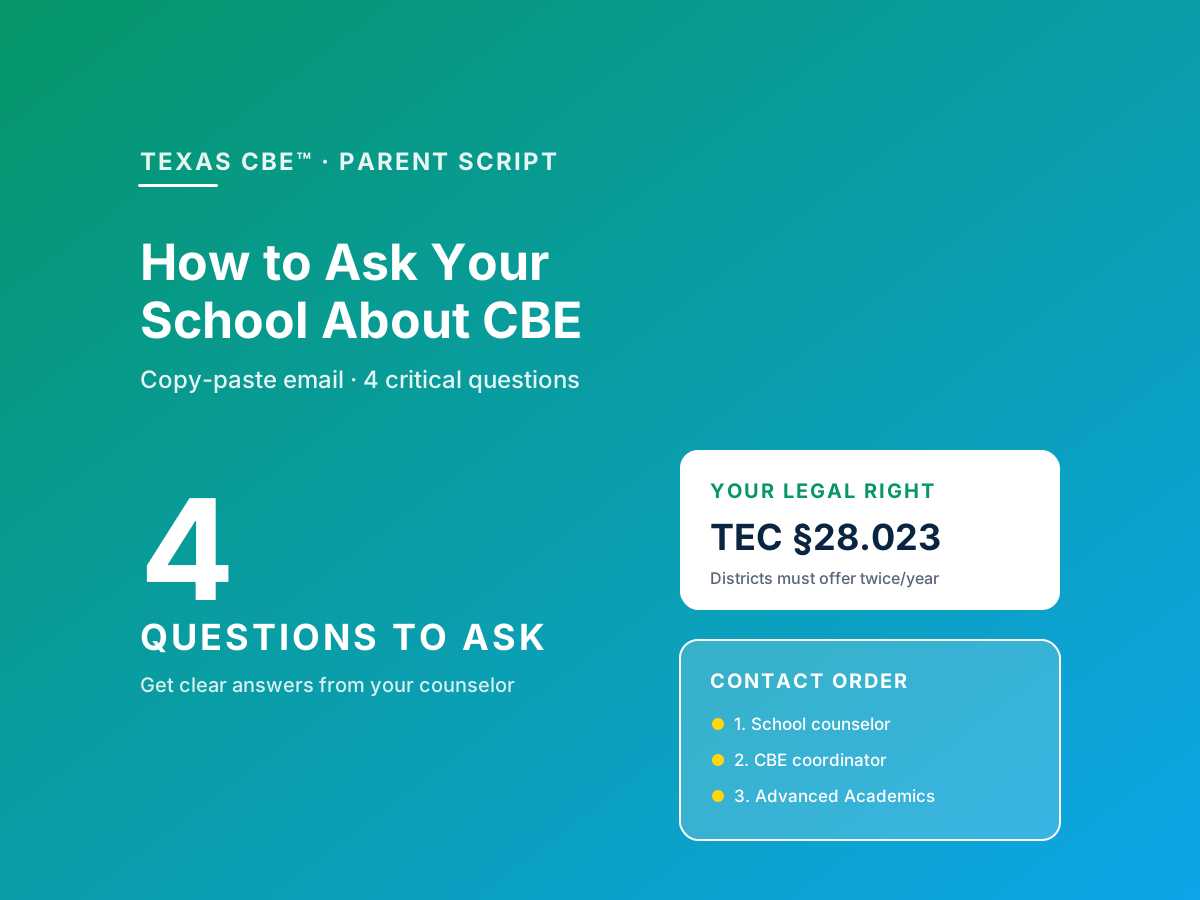
1. Free District Route (TEC §28.023)
- School administers the exam at no cost
- 80% threshold for acceleration
- Districts must offer at least twice per year
- This is the standard path
2. Paid UTHS Route (19 TAC §74.24)
- UT Austin's high school administers the exam
- 70% for credit recovery, 80% for acceleration
- Individual exams: $70 each (district bulk orders: $25-$35)
- Paper exams for K-2 require on-site testing
- At-home Proctorio option available for grades 3-12
Important District Variations
Some districts (like Frisco ISD) require 80% for all CBE credit. Others accept 70%. Always confirm your specific district's threshold before testing.
Who to Contact (In Order)
If your initial contact doesn't get a clear response, escalate up this chain:
- School counselor (primary contact)
- Campus CBE coordinator (often a specific person)
- District Advanced Academics office
- Principal or assistant principal
Start with the counselor. Most CBE requests succeed at step 1.
The Email Template (Copy and Paste)
Subject: Credit by Exam request — [Student name], [grade] grade

Dear Ms./Mr. [Counselor Last Name],

I'm [Your Name], parent of [Student Full Name], a [grade] student
at [School Name]. We're interested in pursuing Credit by Examination
for [Subject — e.g., Algebra I] this school year.

I'd appreciate clarity on:
1. Which CBE routes our district supports — the free §28.023 route,
   the paid §74.24 UTHS route, or both
2. The passing-score threshold our district applies (70% or 80%)
3. When the next test window is and what the registration deadline is
4. What documentation we need to submit

Could we schedule a 15-minute meeting within the next two weeks to
discuss this further?

Thank you for your time,
[Your Name]
[Phone number]
[Email]
Adjust as needed for your situation.
The 4 Critical Meeting Questions
When you meet with the counselor, get clear written answers to these:
1. Does our district offer BOTH §28.023 (free) and §74.24 (paid UTHS) routes?
Some districts only offer one path. Knowing both options helps you choose what's best.
2. What is our district's passing-score policy?
70% or 80%? This dramatically affects prep intensity. A 10-point difference means weeks of additional study.
3. When is the next test window and registration deadline?
Most districts have two windows per year (fall and spring). Don't miss the registration cutoff — it's usually 30-45 days before testing.
4. How does passing CBE credit appear on the transcript?
- Will it show as "EA" (Examination for Acceleration)?
- Will it count in GPA and class rank?
- Will it qualify my child for honors-level next courses?
Get answers in writing.
Documents to Bring to the Meeting
Prepare ahead so the meeting is productive:
- Current class schedule — shows your child's track
- Recent report card or transcript — proves academic standing
- Standardized test scores — NWEA MAP, STAAR, SAT/PSAT
- District's CBE policy from the student handbook
- (Optional) One-paragraph academic rationale — why CBE makes sense for your child
If the School Refuses
Here's the key fact most parents don't know: the §28.023 free district CBE is a legal right. Districts cannot refuse it for required curriculum courses.
If the counselor pushes back:
Strategy 1: Cite the Law
Calmly reference Texas Education Code §28.023 and 19 TAC §74.24 in writing. Most counselors will reconsider once they see you know the law.
Strategy 2: Escalate
Move up the chain: counselor → CBE coordinator → Advanced Academics office → principal. Be persistent but professional. Keep written records.
Strategy 3: Use UTHS Directly
Families can enroll students directly at UT High School for UTHS exams, bypassing district gatekeeping on the exam itself. The district may still need to award transcript credit — escalate if needed.
Strategy 4: File a Complaint
If all internal escalation fails, the Texas Education Agency accepts complaints about district refusal to offer legally-required CBE.
Most situations resolve at Step 1 or 2. Persistence with calm, written references to state law works.
Realistic Timeline
| When | What |
|---|---|
| Week 1 | Email counselor |
| Weeks 2-3 | Meeting and get written answers |
| Weeks 3-4 | Register for CBE |
| 4+ weeks | Focused test prep (use Texas CBE™) |
| Test day | ~3-hour exam |
| 2-4 weeks after | Score posted, transcript updated |
Plan backward from your target testing window.
How to Prepare
Once you've registered, your child needs structured prep. Texas CBE™ (texascbe.com) is built specifically for this:
- 20 free sample questions per subject (no signup)
- TEKS-aligned content matching the official exam
- AI tutoring explains every wrong answer
- Full-length mock exams simulate real test conditions
- $19.99 per subject for 6-month access (regularly $29.99)
The platform's free samples let you verify your child's readiness before committing.
Get 20 Free Practice Questions →Important Cautions
Before pursuing CBE, parents should know:
- CBE doesn't replicate classroom learning — your child gets credit but no in-class instruction time
- Colleges look at trajectory, not CBE itself — admissions cares about reaching AP Calc BC, not flagging CBE
- Self-study motivation matters — your child needs to genuinely engage with the prep
- District policies vary — always confirm specifics with your counselor
CBE works best for students who:
- Have already mastered the subject (e.g., learned it abroad)
- Are highly motivated and disciplined
- Have parental support for self-study
- Want to accelerate toward advanced courses
Bottom Line
Asking your school about CBE doesn't require advocacy expertise — just a clear email, four questions, and willingness to escalate if needed. The legal framework supports parents who want to pursue acceleration.
Action steps this week:
- Copy and send the email template above
- Schedule a meeting with your counselor within 2 weeks
- Get written answers to the 4 critical questions
- Try free Texas CBE™ practice to gauge your child's readiness
- Register for the next testing window
Your child's academic trajectory could change with one email this week.
Start CBE Prep on Texas CBE™ →