CBE Credit on the Transcript: How Texas Colleges Read It (2026 Guide)
Does Credit by Exam (CBE) count for college admissions? Here's exactly how CBE credit appears on transcripts, how it affects GPA and class rank, and how UT Austin, Texas A&M, and other colleges evaluate it.
If your child is testing out of high school courses via Credit by Examination (CBE), one question keeps parents up at night: does this hurt college admissions? Will Texas colleges count it? How does it affect GPA and class rank?
This guide answers all those questions with specifics from Texas law and college admissions practices.
Get Texas CBE™ Prep — Free Sample Questions →What CBE Credit Actually Is
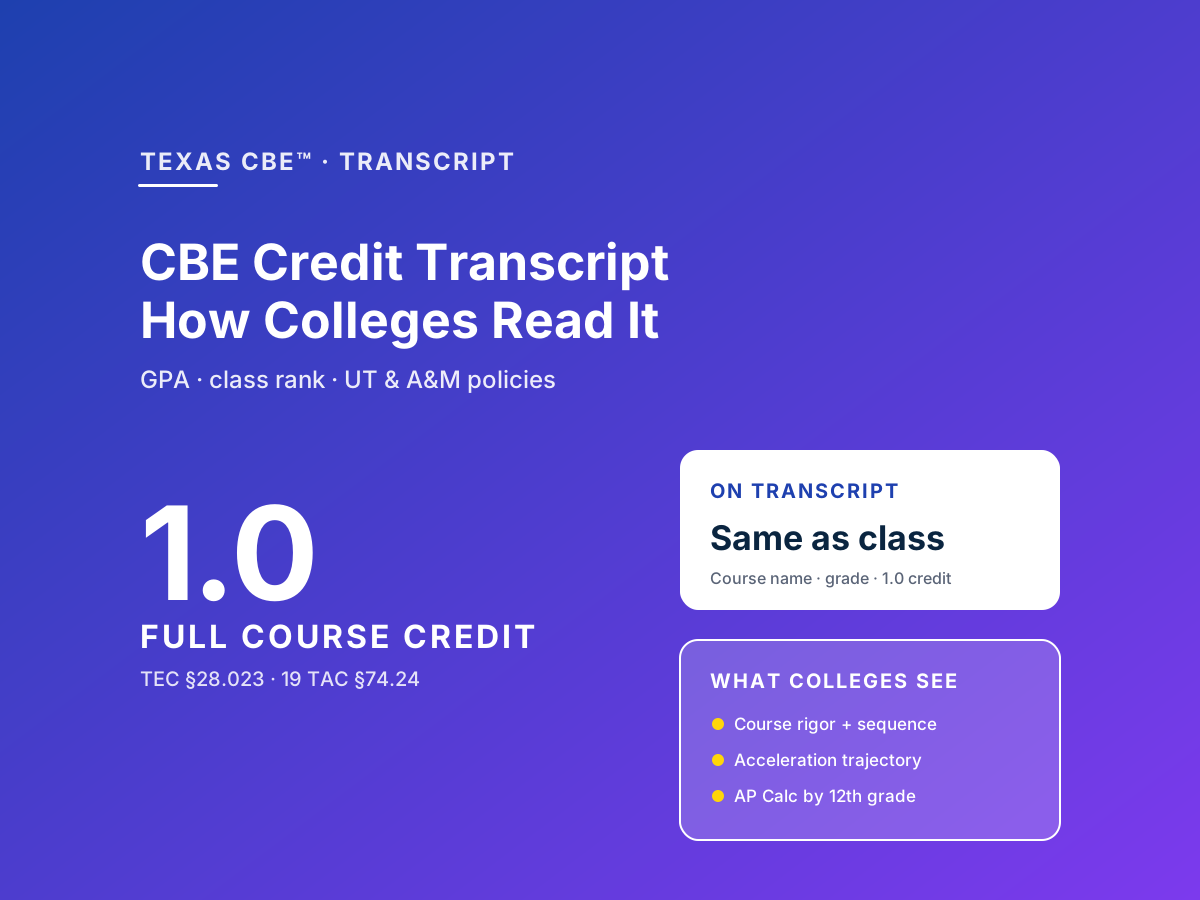
Credit by Examination (CBE) grants permanent high school credit that appears on your child's official transcript — identical to credit earned in a classroom. Under Texas Education Code §28.023 and 19 TAC §74.24, students who pass receive "full course credit as if they had taken the class."
Key distinction: CBE provides acceleration benefits (skipping ahead in your math/science sequence), not college credit itself. For college credit, you need AP exams or Dual Credit courses.
How CBE Appears on the Transcript
A passed CBE shows up with:
| Element | Detail |
|---|---|
| Course name | E.g., "Algebra I" |
| Numeric grade | Your child's exam score |
| Credit value | 1.0 (year-long) or 0.5 (semester) |
| District notation | "EA" (Examination for Acceleration), "CR" (Credit), or similar |
To an admissions officer reading the transcript, this looks like any other completed course — with one small notation indicating credit was earned by examination.
GPA Impact: It Depends on Your District
This is the part families need to understand carefully.
GPA Treatment
Most Texas districts include CBE grades in cumulative GPA, using the exam score as the grade. The weighting typically matches the regular version of the course — NOT honors or AP weighting.
Example:
- Regular Algebra I weight: 4.0 (A) on a 4.0 scale
- Honors Algebra I weight: 4.5
- CBE Algebra I weight: 4.0 (regular, not honors)
If your student would have earned an A in Honors Algebra I (4.5), but instead got a 95 on CBE Algebra I (4.0), they slightly lose weighted GPA. This trade-off needs to be considered.
Class Rank Treatment
This varies significantly by district. Some districts:
- Include CBE grades in class rank calculation
- Exclude CBE grades from class rank
- Use modified weighting
Why this matters: Texas top-X% admissions (UT Austin's Automatic Admission, top 6%) depend heavily on class rank. If your district excludes CBE grades from rank, testing out could affect your child's competitive position.
Action item: Ask your school counselor specifically: "Will CBE grades count in class rank calculation for top-10% admission?"
How Texas Colleges Evaluate CBE
Texas public universities — UT Austin, Texas A&M, UT Dallas, University of Houston, Texas Tech — evaluate three main transcript elements:
- Course rigor and sequencing — Did the student take the most challenging courses available?
- Performance grades — How did they do in each course?
- Overall course load — How many honors, AP, or accelerated courses?
Admissions officers focus on the trajectory — for example, a student reaching AP Calculus BC in 12th grade through earlier CBE acceleration is exactly what they want to see.
They don't flag CBE as different. A student who tests out of Algebra I and Geometry and reaches AP Calculus BC by 12th grade looks identical to one who took every class normally and got there. Both demonstrate strong math trajectory.
CBE vs AP vs Dual Credit
These three pathways serve different purposes:
| Pathway | Earns | Best Use |
|---|---|---|
| CBE | High school credit only | Acceleration — skip what you already know |
| AP | High school + potential college credit | Demonstrate rigor + earn college credit |
| Dual Credit | High school + actual college credit | Earn college credit while still in high school |
A strong strategy combines all three:
- CBE to skip Algebra I → Geometry
- CBE to skip Geometry → Algebra 2
- AP Calculus BC for college credit
- Dual Credit Multivariable Calculus at community college
Critical Things to Verify with Your School
Before registering for any CBE, confirm:
- How is it recorded on the transcript? (Exact notation)
- Is it included in GPA? (Weighted or unweighted)
- Is it included in class rank? (Critical for top-X% admissions)
- Does passing qualify for honors-level next courses?
- What are the district fees and deadlines?
Email your counselor before the testing window opens.
What If My Child Fails the CBE?
Per Texas Education Code §28.023, failed CBE attempts don't appear on the transcript at all. There's zero risk to attempting — only the passing grade is recorded.
This is huge: if your child tries to test out and doesn't pass, nothing is lost. They simply take the regular class.
Out-of-State Colleges
For families considering colleges outside Texas:
- Most out-of-state colleges treat CBE transcript entries as completed courses
- They don't have special policies about Texas CBE specifically
- The course shows up with grade and credit, period
- Strong trajectory matters more than the CBE notation
If your child is applying to MIT, Stanford, or Ivy League schools, the acceleration enabled by CBE is what matters — not the CBE itself.
Real Example: How Admissions Sees It
Student A: Standard math sequence
- 9th: Algebra I
- 10th: Geometry
- 11th: Algebra 2
- 12th: Pre-Calculus
Student B: With CBE acceleration
- Summer before 9th: CBE Algebra I (passed)
- 9th: Geometry
- Summer after 9th: CBE Geometry (passed)
- 10th: Algebra 2
- 11th: Pre-Calculus
- 12th: AP Calculus BC
To admissions officers, Student B looks dramatically stronger — they completed AP Calculus BC, while Student A only reached Pre-Calc.
That's the value of CBE: not the credit itself, but the doors it opens.
Start Math Acceleration with Texas CBE™ →Bottom Line
CBE credit appears on the transcript exactly like classroom credit. It's recognized by Texas colleges and most out-of-state colleges. The key things to verify with your district:
- How CBE affects GPA (usually regular weighting, not honors)
- How CBE affects class rank (varies — critical for top-X%)
- Whether passing qualifies your child for honors-level next courses
The real power of CBE isn't the credit itself — it's the acceleration that lets your child reach AP Calculus BC and other advanced courses. That trajectory is what college admissions value.
Action steps:
- Email your school counselor about CBE transcript and GPA policies
- Try free Texas CBE™ practice questions to gauge readiness
- Map a multi-year acceleration plan
- Coordinate CBE → AP → Dual Credit strategy